5kW Solar System: Daily Output, Panels Needed and 2026 Cost
Short answer
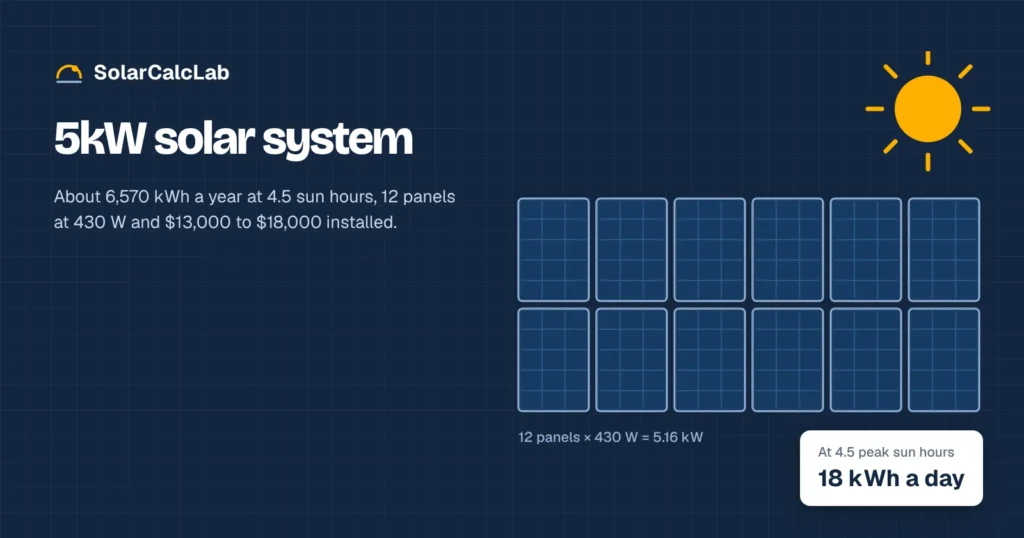
A 5kW solar system produces about 5,500 to 8,000 kWh a year in most of the US, or roughly 15 to 22 kWh a day. At the US middle value of 4.5 peak sun hours that is 18 kWh a day and about 6,570 kWh a year, around 63% of an average American home’s use. It takes 12 panels at 430 W, about 245 to 270 square feet of panel surface, and typically costs $13,000 to $18,000 installed in late 2026.
Five kilowatts is the size many installers quote first for a modest home. It is big enough to wipe out most of the bill in a small, efficient house, yet small enough to fit on one roof face and, in many cases, inside an existing 200 A electrical panel without an upgrade.
This guide covers what a 5kW solar system really produces where you live, how many panels and how much roof it needs, what it can and cannot run, current costs, payback and the inverter that suits it. If you have not yet worked out your target size, start with how many solar panels you need and come back here.
How much does a 5kW solar system produce?
The 5 kW rating is measured in the lab at 1,000 W/m² of sunlight and 25°C cells. On a real roof, heat, wiring, dust and inverter losses take a share, so this site plans with 80% system efficiency. Daily output then depends on your peak sun hours.
Example at the US middle value: 5 × 4.5 × 0.80 = 18.0 kWh a day, or 6,570 kWh a year
Each kilowatt of panels makes about 1,100 to 1,600 kWh a year across most of the US, so 5 kW gives a planning range of 5,500 to 8,000 kWh a year. Sunny desert sites land above that, and cloudy northern coasts slightly below.
| Location | Peak sun hours | Per day | Per month | Per year |
|---|---|---|---|---|
| Phoenix, AZ | 6.3 | 25.2 kWh | 756 kWh | 9,198 kWh |
| Los Angeles, CA | 5.5 | 22.0 kWh | 660 kWh | 8,030 kWh |
| Denver, CO | 5.3 | 21.2 kWh | 636 kWh | 7,738 kWh |
| Dallas, TX | 5.0 | 20.0 kWh | 600 kWh | 7,300 kWh |
| US middle value | 4.5 | 18.0 kWh | 540 kWh | 6,570 kWh |
| Chicago, IL | 4.4 | 17.6 kWh | 528 kWh | 6,424 kWh |
| Seattle, WA | 3.7 | 14.8 kWh | 444 kWh | 5,402 kWh |
Sun hours are approximate annual averages for south-facing panels tilted near latitude, and months are 30 days. Summer days run well above these figures and winter days well below. To model your own address, tilt and azimuth, use the solar panel output calculator.

Is a 5kW solar system enough for your home?
Start with 12 months of bills. The US Energy Information Administration reports that the average residential customer used about 865 kWh a month in 2024, or 10,380 kWh a year. At 6,570 kWh, a 5 kW array covers about 63% of that average.
It is a full match for homes that use roughly 450 to 650 kWh a month, depending on your sun. Here is how the 6,570 kWh figure lines up against a few household types:
| Household | Monthly use (assumed) | Yearly use | Share covered by 5 kW |
|---|---|---|---|
| Condo or small house, gas heat and cooking | 400 kWh | 4,800 kWh | 137% (oversized) |
| Efficient two- or three-bedroom home | 550 kWh | 6,600 kWh | 100% |
| Mid-size home with summer AC | 700 kWh | 8,400 kWh | 78% |
| Average US home (EIA, 2024) | 865 kWh | 10,380 kWh | 63% |
The first three monthly figures are illustrative, so use your own total. Where exports earn far less than retail power, slightly undersizing is usually the better deal.
Turn your bill into a system size
Example: 550 × 12 ÷ (4.5 × 365 × 0.80) = 6,600 ÷ 1,314 = 5.02 kW
The how many solar panels calculator runs this for your ZIP code and panel wattage.
How many panels do you need for a 5kW system?
Divide 5,000 watts by the panel rating and round to a layout that fits. With standard 430 W residential panels, 12 panels give 5.16 kW.
| Panel rating | Panels | Actual array size | Panel area (approx.) |
|---|---|---|---|
| 400 W | 13 | 5.2 kW | about 265 sq ft |
| 430 W | 12 | 5.16 kW | about 255 sq ft |
| 450 W | 11 to 12 | 4.95 to 5.4 kW | about 250 sq ft |
| 500 W (larger format) | 10 | 5.0 kW | about 250 sq ft |
Example: 5,000 ÷ (1,000 × 0.22) = 22.7 m², about 245 sq ft. At 20% efficiency: 25 m², about 269 sq ft
Fire-code setbacks, vents and chimneys eat into the roof, so plan on roughly 300 to 400 square feet of usable, unshaded roof. A 12-panel array fits as two rows of six on most single roof faces, which keeps racking and wiring simple.
What can a 5kW solar system run?
At 18 kWh on an average day, 5 kW covers a home’s base load comfortably: lights, refrigerator, laundry, cooking, electronics and fans. Large electric loads are where it runs short. The table compares common loads with that 18 kWh day.
| Load | Basis (assumed) | kWh per day | Share of 18 kWh |
|---|---|---|---|
| Refrigerator | Typical new full-size model | 1.5 | 8% |
| Electric vehicle | 30 miles × 0.30 kWh per mile | 9.0 | 50% |
| Electric water heater | 4,500 W × 2 hours | 9.0 | 50% |
| Central AC, 3 ton | 3,300 W × 6 hours of compressor time | 19.8 | 110% |
A summer of central air alone can use more than the whole array makes on an average day. Our guide to how many watts an air conditioner uses breaks that load down by unit size. If an EV, heat pump or electric water heater is coming, size up now or choose an inverter with room to expand.
Off grid and backup
For full off-grid living, 5 kW is tight. Winter days in the north can deliver well under half the annual average, so off-grid homes usually pair 5 kW of panels with a large battery and a generator, or step up in size.
How much does a 5kW solar system cost?
Typical US installed prices for a 5 kW residential system in late 2026 run about $2.60 to $3.60 per watt, before any local rebates. Small systems carry a higher price per watt than large ones, because permits, design, interconnection paperwork and inspection cost about the same whatever the size.
| Price per watt | 5 kW total | Typical situation |
|---|---|---|
| $2.60 | $13,000 | Simple roof, competitive market |
| $3.00 | $15,000 | Middle of the market |
| $3.60 | $18,000 | Microinverters, tile roof or high-cost region |
Marketplace data lands in the same band: EnergySage reports an average of about $13,900 for a 5 kW system in 2026, before incentives. Test your own quote in the solar panel cost calculator.
The 30% federal residential clean energy credit (Section 25D) ended for homeowner-owned systems installed after December 31, 2025, so budget the full price in 2026. Leases and PPAs follow separate business credit rules, and some states and utilities still offer rebates or performance payments.
How long does a 5kW system take to pay back?
The examples use a $15,000 system, 6,570 kWh a year and an assumed $0.17 per kWh retail rate.
Example with full net metering: 6,570 × $0.17 = $1,117 a year; $15,000 ÷ $1,117 = 13.4 years
| Scenario | Yearly savings | Simple payback |
|---|---|---|
| Full retail net metering at $0.17 | $1,117 | 13.4 years |
| 70% used at home at $0.17, 30% exported at $0.06 | $900 | 16.7 years |
| Full net metering at a high $0.30 rate | $1,971 | 7.6 years |
Fixed monthly charges and minimum bills do not shrink with solar. Enter your own tariff, export rate and charges in the solar payback calculator.
What inverter and breaker does a 5kW system need?
A 5.0 kW string inverter is the usual pairing with 5.0 to 5.4 kW of panels, giving a DC-to-AC ratio of about 1.00 to 1.08. A 3.8 kW inverter on 5.16 kW of panels pushes the ratio to 1.36, which causes noticeable inverter clipping on bright days. Microinverters suit multi-plane or partly shaded roofs.
Breaker = 20.8 A × 1.25 = 26 A, so a 30 A breaker
Under the NEC 120% rule, a 200 A panel with a 200 A main allows up to 40 A of solar backfeed, so a 30 A breaker fits. A 100 A panel with a 100 A main allows only 20 A, which means a supply-side connection, a smaller main breaker or a panel upgrade. The inverter size calculator checks the ratio for your exact panels.
5kW vs 4kW vs 7kW: which size fits?
| System | Panels at 430 W | kWh per year at 4.5 sun hours | Suits monthly use of about |
|---|---|---|---|
| 4 kW | 10 | 5,256 | 350 to 550 kWh |
| 5 kW | 12 | 6,570 | 450 to 650 kWh |
| 7 kW | 16 to 17 | 9,198 | 650 to 900 kWh |
If your use sits between two sizes, adding a couple of panels during the original install costs far less per watt than adding them later.
Landing between 5 and 7 kW is common, and our 6kW solar system guide shows what that middle size can run for households with an EV or summer AC.
Frequently asked questions
How many kWh does a 5kW solar system produce per day?
About 15 to 22 kWh a day on average in most of the US. Multiply 5 kW by your peak sun hours and by 0.80. At 4.5 sun hours that is 18 kWh a day. Phoenix averages about 25 kWh and Seattle about 15 kWh, with winter days well below average.
How many panels do I need for a 5kW solar system?
Twelve 430 W panels make 5.16 kW. With 400 W panels you need 13, and with 500 W panels 10. The panels cover about 245 to 270 square feet, and you should plan on 300 to 400 square feet of usable roof once setbacks are included.
How much does a 5kW solar system cost in 2026?
Typical installed quotes run about $13,000 to $18,000, or $2.60 to $3.60 per watt, before local rebates. The 30% federal credit for homeowner-owned systems ended for installations after December 31, 2025, so there is no federal discount on a cash or loan purchase in 2026.
Can a 5kW solar system run a house?
It can cover a home using about 450 to 650 kWh a month over a year. An average US home using about 865 kWh a month gets roughly 63% of its power from 5 kW. Homes with central air, an EV or electric heat usually need 7 kW or more.
Can a 5kW solar system run an air conditioner?
On a sunny afternoon, yes: a 3 ton central AC draws about 3,000 to 3,500 W, inside what 5 kW of panels deliver at midday. Over a full summer day, though, six or more hours of compressor time can use around 20 kWh, more than the array’s 18 kWh daily average, so the grid or a battery fills the gap.


