6kW Solar System: Output, Panel Count and What It Can Run
Short answer
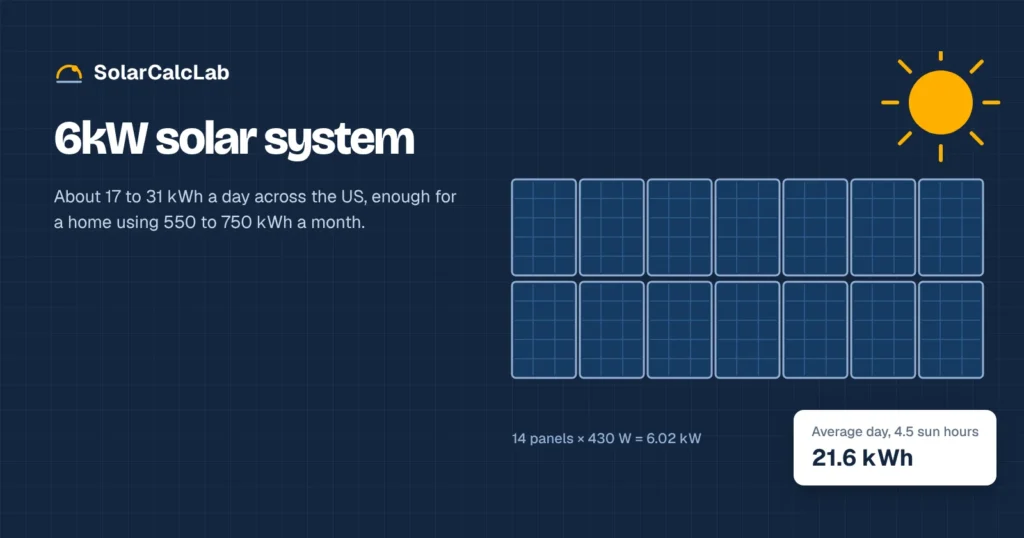
A 6kW solar system makes about 17 to 31 kWh a day in the US, depending on your sun. At 4.5 peak sun hours it averages 21.6 kWh a day, about 650 kWh a month and 7,900 kWh a year. That runs a home using 550 to 750 kWh a month, or a smaller home plus some EV charging. You need 14 panels at 430 W, and the 2026 marketplace average is about $16,080 before incentives.
Six kilowatts sits right in the middle of what American homes actually buy. It is a step up from a starter array, yet still small enough for one or two roof faces and a standard 200 A panel. The useful question is not how much it makes in a lab, but what share of your real life it can power: the fridge and lights, the summer AC, the car in the garage.
How much power does a 6kW system make each day?
A panel’s watt rating is measured at 1,000 W/m² of sunlight with the cells at 25°C. Rooftops run hotter and lose a little to wiring, dust and inverter conversion, so SolarCalcLab plans with an 80% system factor. Peak sun hours do the rest.
At 4.5 sun hours: 6 × 4.5 × 0.80 = 21.6 kWh a day, or 7,884 kWh a year
Instead of a city list, the table below runs the formula across the full spread of US sun. Find your number with the peak sun hours calculator, then read across.
| Peak sun hours | Typical of | kWh per day | kWh per 30 days | kWh per year |
|---|---|---|---|---|
| 3.5 | Western Washington, cloudy coasts | 16.8 | 504 | 6,132 |
| 4.0 | Michigan, upstate New York | 19.2 | 576 | 7,008 |
| 4.5 | US middle value | 21.6 | 648 | 7,884 |
| 5.0 | Southeast, central Texas | 24.0 | 720 | 8,760 |
| 5.5 | Southern California, Colorado | 26.4 | 792 | 9,636 |
| 6.0 | Nevada, New Mexico | 28.8 | 864 | 10,512 |
| 6.5 | Southern Arizona deserts | 31.2 | 936 | 11,388 |
Region labels are rough guides. Our 80% factor is deliberately cautious: the EnergySage 6 kW cost guide uses PVWatts modeling and lists a US average of 8,711 kWh a year, about 23.9 kWh a day. A quote far above both deserves questions.

What can a 6kW solar system run?
The trap is thinking in watts. At noon the array may push 4.5 to 5 kW, but it makes nothing at night, so “running” a home really means covering its yearly kWh through net metering, or covering daytime loads and storing the rest in a battery.
Here is how 7,884 kWh a year (the 4.5 sun hour figure) stacks up against four households. The first, third and fourth monthly figures are examples, so swap in your own bills.
| Household | Monthly use | Yearly use | Share covered by 6 kW |
|---|---|---|---|
| Gas heat and cooking, no EV | 600 kWh | 7,200 kWh | 110% |
| Same home plus an EV driven 12,000 miles | 900 kWh | 10,800 kWh | 73% |
| Average US home (EIA, 2024) | 865 kWh | 10,380 kWh | 76% |
| All-electric home with a heat pump | 1,100 kWh | 13,200 kWh | 60% |
The EV row assumes 0.30 kWh per mile, so 12,000 miles adds 3,600 kWh a year. That one car turns a fully covered home into a 73% covered one, which is why it pays to know about a coming EV before the installer draws the layout.
A sample summer day
Take the 600 kWh home on a sunny 5.0 sun hour day, when 6 kW makes about 24 kWh. Its base use is about 20 kWh, so the array covers the house and exports roughly 4 kWh. Add four hours of central AC compressor time at about 3.3 kW and the home needs 33 kWh. The array is now about 9 kWh short, and that gap lands in the evening when the sun is gone. For loads like this, see how many watts the air conditioner actually uses before deciding the array is too small.
Is 6 kW the right size for your bill?
Reverse the formula to see what size your own use calls for:
Example: 750 kWh a month at 4.5 sun hours: 9,000 ÷ 1,314 = 6.85 kW
As a rule of thumb, 6 kW fits an average monthly use of about 510 kWh in the cloudiest regions up to 950 kWh in the desert. If your answer comes out between 5 and 7 kW, use these tie-breakers:
- Choose closer to 6 kW or a bit under if your utility pays well below retail for exported power. Surplus energy earns little under net billing.
- Go up a few panels if an EV, heat pump or electric water heater is likely within five years. Adding panels during the first install costs far less per watt than a second project.
The solar panel sizing guide walks through the full method, and the neighboring sizes are covered in our 5kW system and 7kW system breakdowns.
How many panels make 6 kW, and where do they go?
| Panel rating | Panels | Array size | Common layout |
|---|---|---|---|
| 400 W | 15 | 6.00 kW | 3 rows of 5 |
| 430 W | 14 | 6.02 kW | 2 rows of 7 |
| 450 W | 13 or 14 | 5.85 or 6.30 kW | 2 rows of 7, or 7 + 6 |
| 500 W | 12 | 6.00 kW | 2 rows of 6 |
Fourteen 430 W panels at 20 to 22% efficiency cover about 295 to 325 square feet. After fire setbacks and vents, plan on roughly 350 to 450 square feet of clear roof. If no single face is big enough, a split between south and west faces works fine with microinverters or optimizers. The solar panel roof area calculator checks the fit for your panel dimensions.
6 kW of panels is not a 6 kW inverter
A “6kW system” is almost always quoted in DC panel watts. The inverter, which sets the AC output, can be smaller, equal or larger. This is a different product from a standalone 6kW inverter, which is rated by what it can power at once, often in off-grid or backup builds.
| Inverter on 6.02 kW of panels | DC-to-AC ratio | What it means |
|---|---|---|
| 5.0 kW | 1.20 | Some clipping at bright midday hours, usually a small yearly loss |
| 6.0 kW | 1.00 | Almost no clipping; the default choice |
| 7.6 kW | 0.79 | Room to add about 1.5 to 3 kW of panels later |
A ratio near 1.2 is common and usually costs little energy; our article on inverter clipping shows when it starts to matter. On the AC side, a 6.0 kW inverter draws 25 A at 240 V, so it needs a 35 A breaker (25 × 1.25 = 31.25 A, rounded up). A 200 A panel with a 200 A main allows 40 A of backfeed under the NEC 120% rule, so that fits. A 7.6 kW inverter needs 31.7 × 1.25 = 39.6 A, a 40 A breaker, which uses the whole allowance. Run your combination through the inverter size calculator.
What does a 6kW system cost per kWh over its life?
EnergySage marketplace data for 2026 puts the average 6 kW system at $16,080 before incentives, or $2.68 per watt.
The 30% federal Residential Clean Energy Credit (Section 25D) does not apply to homeowner-owned systems placed in service after December 31, 2025, as the IRS credit page explains. Budget the full price for a cash or loan purchase in 2026, and check state and utility rebates separately.
A cleaner way to judge the price is cost per kWh over 25 years, assuming 0.5% panel degradation a year:
Cost per kWh = $16,080 ÷ 185,700 = about 8.7 cents
That excludes a likely inverter replacement and any loan interest, but it is a useful yardstick against grid power, which the EIA expects to average about 18 cents per kWh for US homes in 2026.
| Billing setup | Year 1 savings | Simple payback |
|---|---|---|
| Full net metering at 18.2 cents | $1,435 | 11.2 years |
| 70% used at home, 30% exported at 6 cents | $1,146 | 14.0 years |
| 50% used at home, 50% exported at 5 cents | $915 | 17.6 years |
Under net billing, self-consumption matters more than size. Model your own tariff in the solar payback calculator.
Why is my 6kW system producing less than expected?
If monitoring shows numbers well below the table, work through these checks in order:
- Compare the right season. A December day can make well under half of the yearly average, and a June day well above it. Judge output over a full year, not one week.
- Look at the midday curve. A flat top on the power graph means clipping. That is expected with a 5 kW inverter on a clear day.
- Check for new shade. A grown tree or new antenna can hit a whole string on a string inverter system. Panel-level monitoring shows which modules lag.
- Read the bill and the app together. The bill shows only exports and imports. Energy used directly in the house never appears on it, so the bill can look low even when the array performs well.
If output stays more than 15 to 20% below the installer’s estimate over a full year, ask for the production guarantee terms in writing.
Frequently asked questions
How many kWh does a 6kW solar system produce per month?
About 500 to 950 kWh a month on a yearly average, depending on location. At 4.5 peak sun hours it is about 650 kWh in a 30-day month. Summer months come in higher and winter months lower.
Can a 6kW solar system power an EV?
Yes, partly or fully. At 0.30 kWh per mile, the 7,884 kWh a 6 kW array makes in a typical US year equals about 26,000 miles of driving if all of it went to the car. In practice the home takes most of it, so an EV driven 12,000 miles adds about 3,600 kWh a year to what the array has to cover.
Is a 6kW system enough for a 2,000 square foot house?
Square footage is a weak guide. A 2,000 square foot home with gas heat and modest AC may use 700 kWh a month, which 6 kW covers in sunnier states. The same home with electric heat or a pool pump can need a much larger array. Use 12 months of bills instead. For the full breakdown by home size, city and heating fuel, see how many solar panels a 2,000 sq ft house needs.
Will a 6kW system work during a power outage?
Not on its own. Grid-tied inverters shut down when the grid fails so they do not send power onto lines crews are working on. You need a battery with a backup gateway, or a hybrid inverter that can island the home, to use solar during an outage.
What size battery pairs well with a 6kW solar system?
For evening use and short outages, 10 to 15 kWh is common. That stores half to two-thirds of a typical day’s 21.6 kWh output. Sizing to cover a full day of use without sun needs a larger bank and usually a bigger array too.


